最新消息

李宥萱 Yu-Hsuan, Lee

CURRENT POSITION

Associate Professor, Institute of Environmental and Occupational Health Sciences, School of Medicine, National Yang Ming Chiao Tung University, Taipei, Taiwan

ADDRESS

Room 303, Medical Building II
No. 155, Sec. 2, Linong St. Beitou Dist., Taipei City 112304, Taiwan

EDUCATION

Ph.D.

2010-2015

Department of Environmental and Occupational Health, College of Medicine, National Cheng Kung University, Tainan, Taiwan

M.S.

2006-2008

Department of Environmental and Occupational Health, College of Medicine, National Cheng Kung University, Tainan, Taiwan

B.S

2002-2006

Department of Occupational Safety and Health, Chung Shan Medical University, Taichung, Taiwan

AWARDS and HONORS

  • Travel Award, EMBO conference-Structure and function of the endoplasmic reticulum, Girona, Spain. 23-27 Oct, 2016.
  • Innovative BioDesign Award, National Cheng Kung University, Tainan, Taiwan. 28 Jun, 2017
  • Second place in Startup Competition, National Cheng Kung University, Tainan, Taiwan. 6 Jan, 2018
  • Best Poster Award. The 34th Joint of Annual Conference of Biomedical Science, Taipei, Taiwan. 23-24 Mar, 2019.
  • Executive Secretary. 1st winter camp congress of the Taiwan Society of Toxicology. 26-28 Jan, 2019.
  • MOST Research Grants (Rewarding Outstanding Talent) 2021
  • Best Poster Award. The 37th Joint of Annual Conference of Biomedical Science, Taipei, Taiwan. 18-19 Mar, 2023
  • Outstanding Paper Award. Chinese Society of Toxicology 9th National Youth Science and Technology Conference and 2nd Academic Conference on Biotechnology Drug Toxicology and Safety Evaluation Committee, Xiamen 29-31 Oct, 2023
  • MOST Research Grants (Rewarding Outstanding Talent) 2024
  • Hwa Ren Youth Chair Professor Award 2025

MEMBERSHIPS

Deputy convener of Academic Technology Committee in Toxicology Society of Taiwan (TSTA), (2022-present)
Member of Toxicology Society of Taiwan (TSTA), (2017-present)

Member of Taiwan Nanomedicine Society, (2019-present)

SERVICE

Current

Associate Professor, Institute of Environmental and Occupational Health Sciences, School of Medicine, National Yang Ming Chiao Tung University (2025/08-present)

Past

Associate Professor, Department of Cosmeceutics, China Medical University (2023/08-2025/07)
Assistant Professor, Department of Cosmeceutics, China Medical University (2019/08-2023/07) 

Project Assistant Professor, Department of Food Safety / Hygiene and Risk Management, College of Medicine, National Cheng Kung University (2017/08-2019/07)

Post-doctoral Fellow, Department of Environmental and Occupational Health, College of Medicine, National Cheng Kung University (2015/08-2017/07)

Professional and Research Experience

Environmental toxicology, Research on Health Effects of Emerging Contaminants, Skin immunology, Nanomedcine / Nanotoxicology, Natural compounds prevent allergic contact dermatitis

PUBLICATIONS

  • C-C Chang, S-C Fan, Y-J Wang, J-W Ping, Y-H Su, J-C YANG, Y-X Chan, Y-X YANG, Y-H Lee, C-C Chang, C-H Lin, T-Y Juang *Hyperbranched Polymer Dots Enhance Hair Follicle Regeneration via Wnt/β-Catenin Activation: A Drug-Free Nanozyme-Based Approach to Hair Growth Therapy. Biomedicine & Pharmacotherapy 188, 118196 (2025) (S.C.I. Impact factor: 7.5. Subject Category: 19/352=5.4% in Pharmacology & Pharmacy, JCR 2024)
  • Y-H Lee, C-M Zheng, Y-J Wang, Y-L Wang and H-W Chiu*. Effects of microplastics and nanoplastics on the kidney and cardiovascular system. Nature Reviews Nephrology 21, 585–596 (2025) (S.C.I. Impact factor: 39.8, 2/133=1.5% in Urology & Nephrology, JCR 2024) (First author)
  • Y-L Wang#, Y-C Lin#, W-C Liu, Y-H Lee* and H-W Chiu*. Air pollution and its impacts on health: Focus on microplastics and nanoplastics. Ecotoxicology and Environmental Safety 299, 118402 (2025) (S.C.I. Impact factor: 6.1. Subject Category: 10/106=9.4% in Toxicology, JCR 2024) (Corresponding author)
  • C-C Chang, H-M Lao, S-C Fan, Y-H Tu, J-C Siew, K-C Ma, Y-H Lee, H-M Chiang, C-C Chang, T-Y Juang *. Bioactive hyperbranched polymer dot combined laser-induced optical breakdown for accelerating wound repair and regeneration in a nude mice mode. Materials Advances 6(10):3185-3202 (2025) (S.C.I. Impact factor: 4.7. Subject Category: 207/462=44.8% in Materials Science, Multidisciplinary, JCR 2024)
  • H-W Chiu, C-W Chu, C-Ca Huan, Z-C Chia, Y-L Wang, Y-H Lee*. Polystyrene microplastics induce hepatic lipid metabolism and energy disorder by upregulating the NR4A1-AMPK signaling pathway. Environmental Pollution 369, 125850 (2025). (S.C.I. Impact factor: 7.3. Subject Category: 46/374=12.3% in Environmental Sciences, JCR 2024) (Corresponding author)
  • Y-H Cheng, H-I. Wu, Y-Y Chen, Y-H Lee, B-J Wang* and Y-J Wang*. Adverse outcome pathway-based approach to reveal the mechanisms of skin sensitization and long-term aging effects of chlorothalonil. Journal of Hazardous Materials 476, 135176 (2024). (S.C.I. Impact factor: 11.3. Subject Category: 19/374=5.1% in Environmental Sciences, JCR 2024)
  • B-J Wang, Y-Y Chen, H-H Chang, R-J Chen, Y-J Wang* and Y-H Lee*. Zinc oxide nanoparticles exacerbate skin epithelial cell damage by upregulating pro-inflammatory cytokines and exosome secretion in M1 macrophages following UVB irradiation-induced skin injury. Particle and Fibre Toxicology. 21, 9 (2024). (S.C.I. Impact factor: 8.2. Subject Category: 5/106=4.7% in Toxicology, JCR 2024) (Corresponding author)
  • *. Oxidative stress and potential effects of metal nanoparticles: a review of biocompatibility and toxicity concerns. Environmental Pollution 346, 123617 (2024) (S.C.I. Impact factor: 7.3. Subject Category: 46/374=12.3% in Environmental Sciences, JCR 2024)
  • Y-L Wang#, C C-Y Huang, C-M Zheng, W-C Liu, Y-H Lee# and H-W Chiu*. Polystyrene microplastic-induced extracellular vesicles cause kidney-related effects in the crosstalk between tubular cells and fibroblasts. Ecotoxicology and Environmental Safety 273, 116098 (2024) (S.C.I. Impact factor: 6.1. Subject Category: 10/106=9.4% in Toxicology, JCR 2024) (co-First author)
  • H-J Huang#, Y-H Lee, L-C Sung, Y-J Chen, Y-J Chiu, H-W Chiu# and C-M Zheng*. Drug repurposing screens to identify potential drugs for chronic kidney disease by targeting prostaglandin E2 receptor. Computational and Structural Biotechnology Journal 21, 3490–3502 (2023) (S.C.I. Impact factor: 4.1. Subject Category: 104/319=32.6% in Biochemistry & Molecular Biology, JCR 2024)
  • W-C Liu, H-W Chiu, C-L Chou, Y-J Chiu and Y-H Lee*. Lactoferrin attenuated urban particulate matter-induced nephrotoxicity by regulating the CSF2/CENPE axis. Environmental Pollution 318, 120871 (2023). (S.C.I. Impact factor: 7.3. Subject Category: 46/374=12.3% in Environmental Sciences, JCR 2024) (Corresponding author)
  • C-M Zheng, K-C Lu, Y-J Chen, C-Y Li, Y-H Lee* and H-W Chiu*. Matrix metalloproteinase-7 promotes chronic kidney disease progression via the induction of inflammasomes and the suppression of autophagy. Biomedicine & Pharmacotherapy 154, 113565 (2022). (S.C.I. Impact factor: 7.5. Subject Category: 19/352=5.4% in Pharmacology & Pharmacy, JCR 2024) (Corresponding author)
  • Z-Y Chen, Y-C Yang, B-J Wang, F-Y Cheng, Y-L Lee, Y-H Lee* and Y-J Wang*. Comparing different surface modifications of zinc oxide nanoparticles in the developmental toxicity of zebrafish embryos and larvae. Ecotoxicology and Environmental Safety 243, 113967 (2022). (S.C.I. Impact factor: 6.1. Subject Category: 10/106=9.4% in Toxicology, JCR 2024)(Corresponding author) H-J Huang, Y-H Lee, C-L Chou, C-M Zheng*and H-W Chiu*. Investigation of potential descriptors of chemical compounds on prevention of nephrotoxicity via QSAR approach. Computational and Structural Biotechnology Journal 20,1876-1884 (2022). (S.C.I. Impact factor: 4.1. Subject Category: 104/319=32.6% in Biochemistry & Molecular Biology, JCR 2024).
  • W-C Liu#, H-C Chuang, C-L Chou, Y-H Lee, Y-J Chiu, Y-L Wang# and H-W Chiu*. Cigarette smoke exposure increases glucose-6-phosphate dehydrogenase, autophagy, fibrosis and senescence in kidney cells in vitro and in vivo. Oxidative Medicine and Cellular Longevity 2022, 5696686(2022).
  • B-H Mao#, Y-K Luo, B-J Wang, C-W Chen, F-Y Cheng, Y-H Lee#, S-J Yan*, Y-J Wang*. Use of an In silico Knowledge Discovery Approach to Determine Mechanistic Studies of Silver Nanoparticles-induced Toxicity from In vitro to In vivo. Particle and Fibre Toxicology. 19, 6 (2022). (S.C.I. Impact factor: 8.2. Subject Category: 5/106=4.7% in Toxicology, JCR 2024) (co-First author)
  • Y-Y Chen#, Y-H Lee#, B-J Wang, R-J Chen, Y-J Wang. Skin Damage Induced by Zinc Oxide Nanoparticles Combined with UVB is Mediated by Activating Cell Pyroptosis via the NLRP3 Inflammasome-Autophagy-Exosomal Pathway. Particle and Fibre Toxicology. 19, 2 (2022). (S.C.I. Impact factor: 8.2. Subject Category: 5/106=4.7% in Toxicology, JCR 2024) (co-First author)
  • Y-L Wang#, Y-H Lee, Y-H Hsu, I-J Chiu, C C-Y Huang, C-C Huang, Z-C Chia, C-P Lee, Y-F Lin# and H-W Chiu*. The kidney-related effects of polystyrene microplastics on human kidney proximal tubular epithelial cells HK-2 and male C57BL/6 mice. Environmental Health Perspectives 129(5), 57003 (2021). (S.C.I. Impact factor: 9.8. Subject Category: 3/106=2.8% in Toxicology, JCR 2024)
  • Y-L Wang, C-M Zheng, Y-H Lee, Y-Y Cheng, Y-F Lin and H-W Chiu*. Micro- and nanosized substances cause different autophagy-related responses. International Journal of Molecular Sciences 22, 4787 (2021). (S.C.I. Impact factor: 4.9. Subject Category: 72/319=22.6% in Biochemistry & Molecular Biology, JCR 2024)
  • H-J Huang, Y-H Lee, Y-H Hsu, C-T Liao, Y-F Lin* and H-W Chiu*. Current strategies in assessment of nanotoxicity: Alternatives to in vivo animal testing. International Journal of Molecular Sciences 22, 4216 (2021). (S.C.I. Impact factor: 4.9. Subject Category: 72/319=22.6% in Biochemistry & Molecular Biology, JCR 2024)
  • Y-H Hsu#, C-M Zheng, C-L Chou, Y-J Chen, Y-H Lee#, Y-F Lin*, H-W Chiu*. Therapeutic effect of endothelin-converting enzyme inhibitor on chronic kidney disease through the inhibition of endoplasmic reticulum stress and the NLRP3 inflammasome. Biomedicines 9, 398 (2021). (S.C.I. Impact factor: 3.9. Subject Category: 88/352=25.0% in Pharmacology & Pharmacy, JCR 2024) (co-First author)
  • R‑J Chen#, C-C Huang, R Pranata, Y‑H Lee#, Y-Y Chen, Y-H Wu*, Y‑J Wang*. Modulation of innate immune toxicity by silver nanoparticle exposure and the preventive effects of pterostilbene. International Journal of Molecular Sciences 22, 2536 (2021). (S.C.I. Impact factor: 4.9. Subject Category: 72/319=22.6% in Biochemistry & Molecular Biology, JCR 2024) (co-First author)
  • R‑J Chen#, Y‑H Lee#, T‑H Chen, Y‑Y Chen, Y‑L Yeh, C‑P Chang, C‑C Huang, H-R Guo*, Y‑J Wang*. Carbon monoxide‑triggered health effects: the important role of the inflammasome and its possible crosstalk with autophagy and exosomes. Archives of Toxicology 95(4):1141-1159 (2021). (S.C.I. Impact factor: 6.9 Subject Category:8/106=7.5% in Toxicology, JCR 2024). (co-First author)

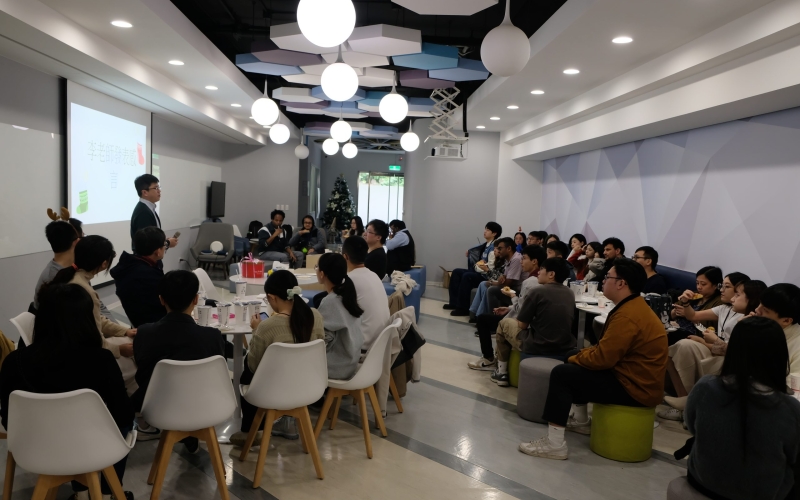
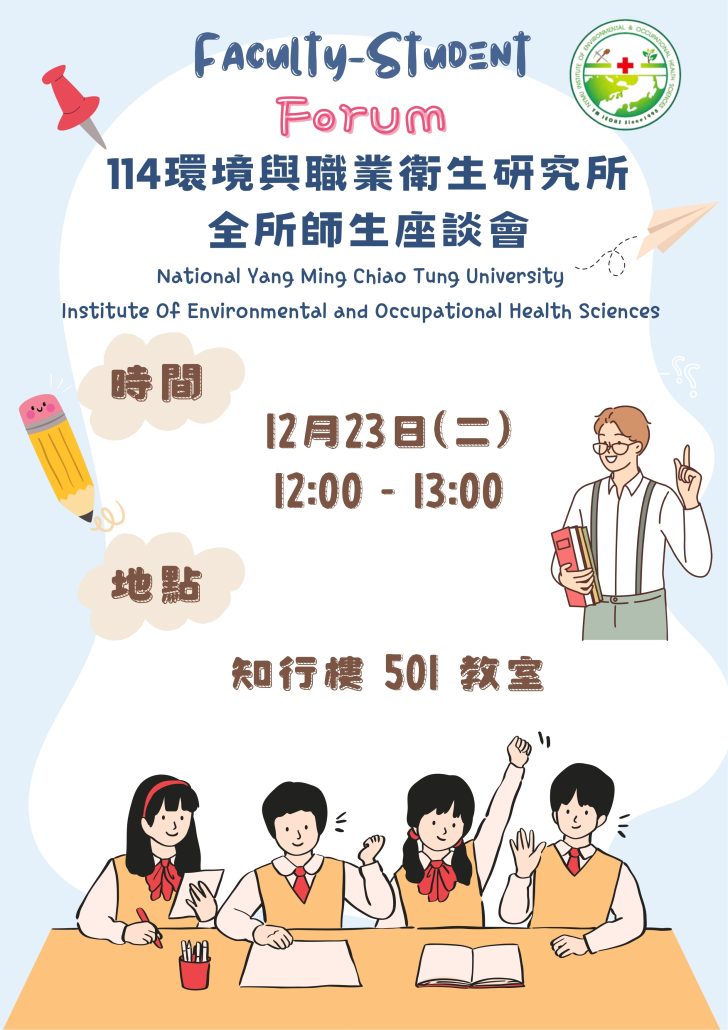
【師生座談會】114 學年度環境與職業衛生研究所全所師生座談會

為促進師生交流與課程/研究意見回饋,本所將於學期末舉辦「114 學年度環境與職業衛生研究所全所師生座談會(Faculty–Student Forum)」。活動安排由所長與師長向同學說明本所發展方向與課程規劃,並開放同學就修課經驗、研究訓練、實習與未來升學就業等議題提出建議與討論,作為後續精進教學與課程設計之重要參考。

誠摯邀請本所全體教師與在學生準時出席,一同交流本學期的學習與研究心得。

  • 活動日期:2025 年 12 月 23 日(星期二)
  • 活動時間:12:00–13:00
  • 活動地點:知行樓 501 教室
  • 參加對象:本所全體師生
  • 主辦單位:國立陽明交通大學 環境與職業衛生研究所

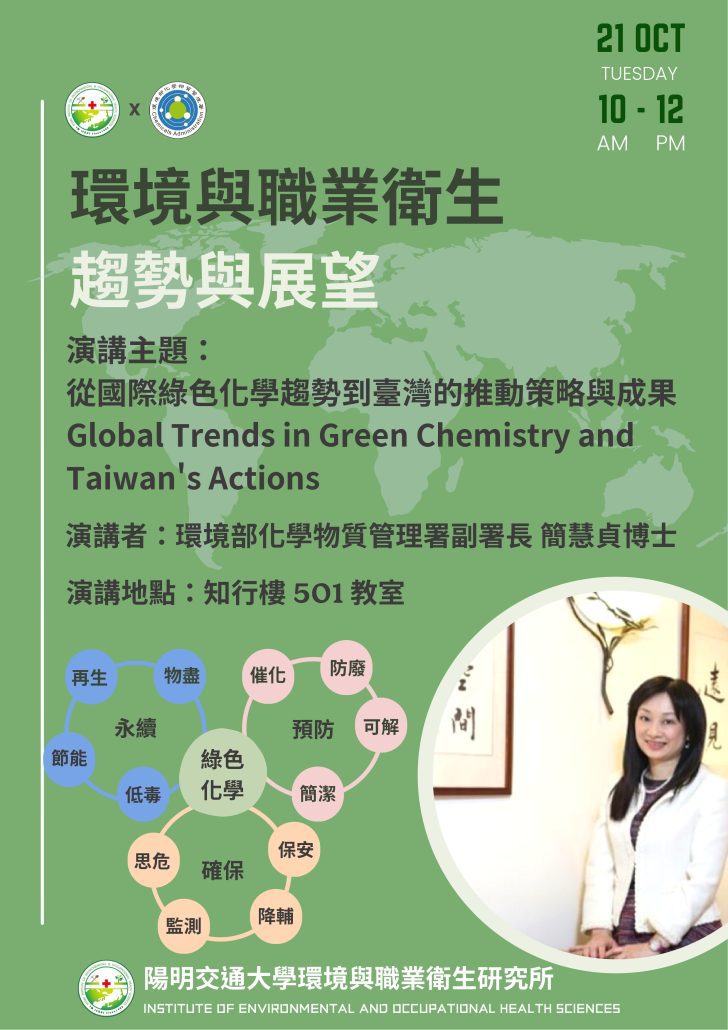
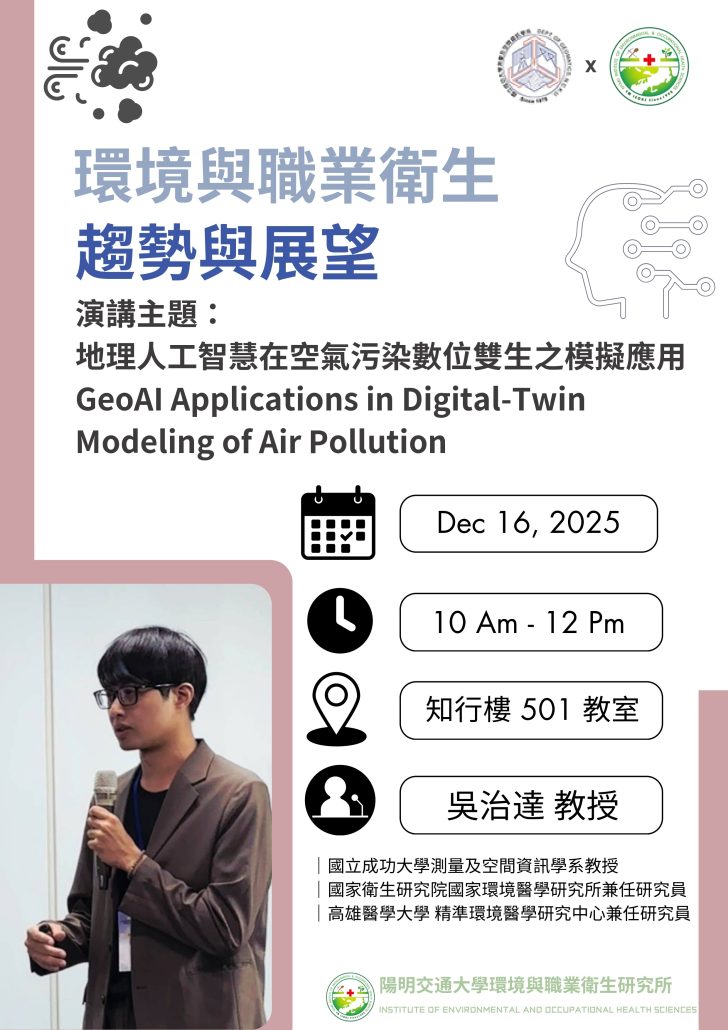
【專題演講】環境與職業衛生趨勢與展望:地理人工智慧在空氣污染數位孿生之模擬應用

國立陽明交通大學環境與職業衛生研究所將於 12 月 16 日舉辦「環境與職業衛生趨勢與展望」專題演講,主題為「地理人工智慧在空氣污染數位孿生之模擬應用(GeoAI Applications in Digital-Twin Modeling of Air Pollution)」,由本所邀請專家學者分享 GeoAI 與數位孿生技術於空氣污染監測與風險評估上的最新應用與發展。

徵才!! 婦幼專案辦公室新生兒科招募專任研究助理

一、公告標題婦幼專案辦公室新生兒科招募專任研究助理(兒童於孕期與成長期暴露環境污染物對健康影響之探討)
二、職等:
三、職系:
四、職稱:專任研究助理
五、名額:正取1名,備取2名(候補期間至多3個月)
六、資格條件:(一)本職務係本院自行遴用之人員,不具有公務人員身分,相關權利義務於契約書約定。 (二)待遇:基本月薪新台幣38,000元,另享有勞健保。 (三)進用期間:自115年01月01日起至116年12月31日止。 (四)報名條件:     1.具中華民國國籍(大陸地區人民經許可進入臺灣地區設有戶籍滿10年以上),且無公務人員任用法第28條第1項、臺灣地區與大陸地區人民關係條例第21條第1項規定情形。     2.學歷:國內外公衛.醫學.護理.資訊相關學系畢業,學士級(或以上)。
【如為本年度應屆畢業生,應繳證件請詳閱「備註欄」。】     3.經歷:熟悉統計軟體(如SPSS.SAS)操作,具有計畫收案、流病統計、護理背景、撰寫報告或寫程式等經驗者為佳。     4.其它要求:具身心障礙手冊者尤佳。         5.甄試地點:本院婦幼院區(臺北市中正區福州街12號)9樓小兒科辦公室    
七、工作項目:(一)「兒童於孕期與成長期暴露環境污染物對健康影響之探討」計畫行政作業。 (二)臨床收案、聯絡個案、個案管理。 (三)個案資料整理以及分析。 (四)其他臨時交辦事項。
八、工作地點:臺北市立聯合醫院婦幼院區(臺北市中正區福州街12號)※本院為無菸無檳職場。
九、聯絡方式:小兒科林小姐:聯絡電話02-23941729,請於週一至週五上班時間來電。
請將履歷寄給 王培瑋 醫師 (DAE61@tpech.gov.tw)

醫學二館教室借用方式

🚨🚨🚨🚨關於醫學二館教室借用方式之說明如下:

本所師生如需借用醫學二館教室(含公共衛生群相關教室),可透過【醫學院公衛群教師預約系統】查詢教室使用情形

🔎 教室預約查詢系統
👉 https://ihp.nycu.edu.tw/reserve/index.php

✅ 實際的借用申請填寫Google表單,以利後續協調及確認流程:

📋 環衛所師生借用教室申請單 :
👉 https://forms.gle/ueCBv1WmJ3mpCXvz6

提醒事項:

  1. 請先透過預約系統查詢教室時段是否空檔,再填寫借用表單。
  2. 教室借用將依實際需求及教學活動安排為主,由所辦協助統一處理。
  3. 若有特殊需求請事先與所辦聯繫,以便協助安排。

造成不便敬請見諒,感謝您的理解與配合🙇

114 碩士班考試入學招生
初試合格名單與複試報到須知

環境與職業衛生研究所

初試合格25名

口試報到日期 114年3月14日()

報到地點:醫學二館一樓大廳

面試地點:醫學二館105

※請於報到時間準時報到,每一時段準時於報到時間後十分鐘開始。

※請攜帶有照片之證件(身分證或健保卡)以及報到通知單

※請攜帶面試報告資料七份(請詳請參閱簡章) 。

●注意事項:

(1)請詳閱各所組簡章分則內複試應備文件及注意事項欄位。

(2)請自行閱讀本校簡章總則考試方式之複試相關說明

(3)考生如有遺漏系所及簡章相關說明,權益請自行負責。

(4)未依規定報到者以放棄複試資格論,不得任何要求補行複試。

(5)陽明校區處山坡地,交通較為不便,請預留報到時間。

[12:50報到]
0100002

0100003

0100004

0100006

0100007

0100008

[13:50報到]
0100011

0100012

0100014

0100015

0100018

0100019

[14:50報到]
0100022

0100023

0100024

0100034

0100038

0100039

[15:50報到]
0100040

0100041

0100042

0100044

0100049

0100052

0100054